

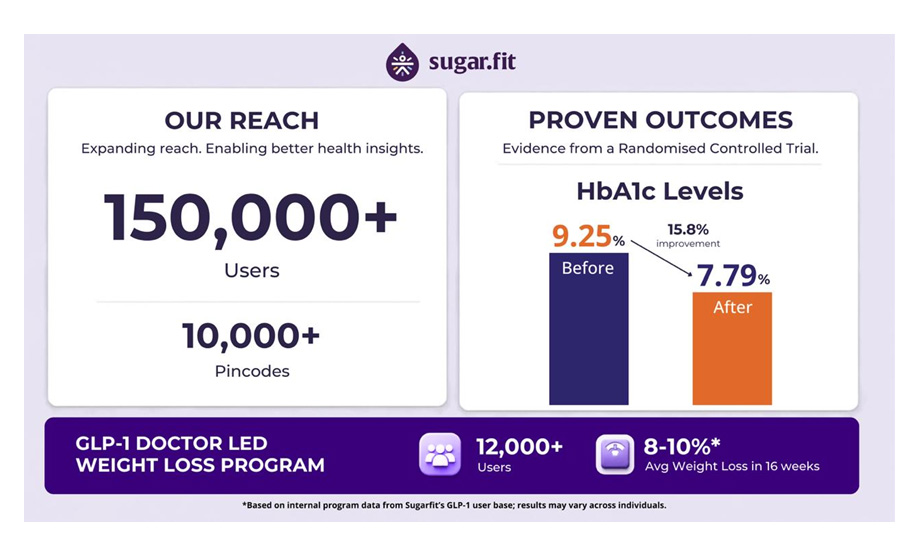
Bengaluru, (Karnataka) [India] 26 August: Sugarfit, India’s evidence-led metabolic health platform, today announced the publication of findings from its multicentre randomized controlled trial (RCT) in Frontiers in Endocrinology. The study found that participants using Sugarfit’s structured metabolic care program achieved an average 1.46% reduction in HbA1c over 90 days, compared with a 0.07% increase among participants receiving standard care alone (p<0.001).
Conducted across four specialty diabetes centres in India, the study provides clinical evidence for a digitally delivered, coach-supported model combining personalised nutrition, physical activity, mental wellness support and technology-enabled monitoring.
Study demonstrates significant improvements in glycemic and metabolic outcomes
The findings have been published in Frontiers in Endocrinology, a peer-reviewed journal indexed in PubMed/MEDLINE, Embase, Scopus and Web of Science, with a current Impact Factor of 5.7.
Beyond HbA1c, participants in the Sugarfit program demonstrated significantly greater improvements in fasting blood sugar, body weight, BMI, waist circumference and diabetes-related distress.
The study also found a clear association between program adherence and outcomes, with participants who had higher adherence achieving a greater HbA1c reduction of 1.7%.
“This trial shows what is possible when technology enables structured, continuous support at scale. Traditional diabetes care can often be episodic, with patients seeing their doctor every few months and managing largely on their own between visits. By enabling continuous monitoring, personalised support and timely interventions, digital health can help bridge that gap. The 1.46% reduction in HbA1c over 90 days gives us confidence in the potential of this approach to strengthen diabetes care,” said Shivtosh Kumar, Co-founder and Chief Product Officer, Sugarfit.
Bringing a doctor-led care model to the GLP-1 era
The RCT findings build on Sugarfit’s broader focus on delivering structured, evidence-led support across the metabolic health journey. As treatment approaches evolve, Sugarfit has expanded this model into doctor-led GLP-1 care, with more than 12,000 users now enrolled in its GLP-1 program.
Users in the internal program have achieved around 8–10% average weight loss within 16 weeks. The program combines physician-led treatment with personalised nutrition, progressive fitness, behavioural support and continuous monitoring, with a particular focus on achieving weight loss while supporting muscle preservation and broader metabolic health.
“GLP-1 therapies are a major step forward in metabolic health, but the medication is only one part of the equation. The real opportunity is to build a complete care model around these therapies, bringing together doctors, nutrition, exercise, behavioural support and real-time health data,” said Dr. Chhavi Mehra, Chief Medical Officer, Sugarfit.
Across diabetes and obesity care, Sugarfit has now generated more than 1.6 billion longitudinal health data points across 10,000+ pincodes, creating a growing real-world view of how Indians respond to food, activity, medication and structured metabolic interventions over time. This data is helping Sugarfit better understand individual patterns and inform more personalised, responsive care.
Building the evidence base for the next generation of metabolic care
The RCT publication is part of Sugarfit’s broader research agenda, with work presented at scientific forums including ADA, EASD, ATTD, ICE and RSSDI, alongside ongoing real-world evidence studies and research collaborations.
“This publication is an important milestone, but also a starting point. The next phase of metabolic healthcare will be increasingly personalised, continuous and evidence-driven, and our priority is to deepen the clinical evidence around this approach,” said Annie M Raymond, Head of Research and Development, Sugarfit.
What Comes Next
Sugarfit’s next phase is focused on building a more integrated metabolic care ecosystem, bringing together digital care, physicians, diagnostics, connected devices and in-person touchpoints across diabetes, obesity and broader metabolic health.
“We believe the future of metabolic care will not just sit within a clinic, medication or device. It will be an interconnected care system that can meet people wherever they are and continuously adapt to their changing needs. The next few years at Sugarfit will be about building that system at scale,” said Madan Somasundaram and Shivtosh Kumar, Co-founders, Sugarfit.
For updates on research and clinical evidence, visit sugarfit.com.